


“Green, pink and burgundy tongues”
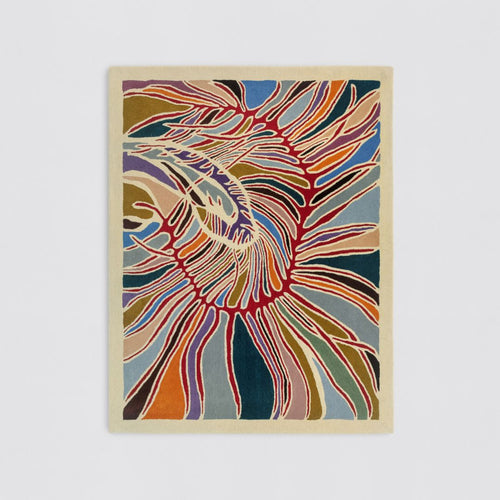
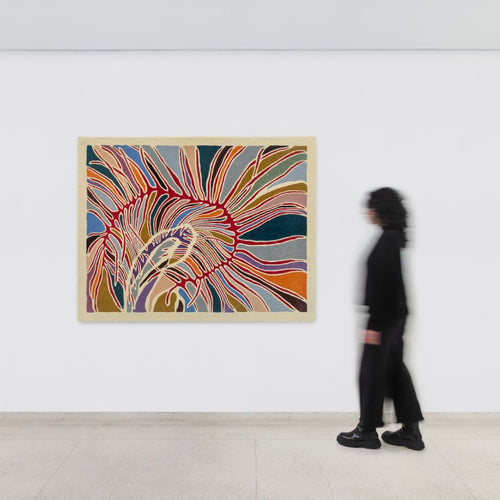
Green, pink and burgundy tongues
(SKU. 8720)
-
Date
2019 -
Technique
tapestry -
Dimensions
(H x W x D) 154 x 130 x 1 cm -
Edition
20 + 3PA -
Comes with certificate of authenticity
Couldn't load pickup availability
Marcia de Moraes is known for her drawings and collages made in graphite and colored pencil. In the tapestries, created especially for Carbono Galeria, it is clear that the artist's visual vocabulary - tongues, branches, open circles, ovaries, bones, cords, etc. - is still present, but transposed to the language of textiles.
In an artisanal process, carried out by a team of weavers who mix the fabric on specialized sewing machines and manual finishing, each piece is unique in a series of 20 + 3 PAs. In all the tapestries the same image is maintained, but the colors are not repeated, just like the artist's modus operandi in her drawings and collages, whose color combinations are always unique.
In the tapestry designs, the lines gain thickness, and they are filled, this time, by the accumulation of thousands of threads. The encounters of dozens of colors act as contours of multiple, inconstant and almost confusing situations that are situated in zones of indeterminacy between the abstract and the figurative.


Biography

Marcia de Moraes
Marcia de Moraes finds in the abstraction of line and the use of colored pencils the poetic direction for her creations. Her work begins with fluid and agile graphite sketches, which then gain intense colors and unique combinations. The result is compositions in constant transformation, in which lines and hues cross the boundaries of the paper. Frequently articulated in diptychs, polyptychs, and collages, her works explore the rhythm between continuity and rupture, achieving three-dimensionality in recent experiments with glazed ceramics.
With a Bachelor's and Master's degree in Arts from Unicamp, Marcia develops research focused on drawing and the expressiveness of organic forms, exploring the balance between technical control and lyrical improvisation. Her work engages with the legacy of Brazilian abstraction, evoking movement and emotional density in intense chromatic compositions.
Among her main solo exhibitions are “Electric Scenes”, Simões de Assis Gallery, Balneário Camboriú (2025); “Bone Point”, Artium Institute, São Paulo (2024); “Matrix”, Leme Gallery, São Paulo (2022); “The Third”, Banco do Brasil Cultural Center, São Paulo (2021); “Open Circles”, SESI Tiradentes – Yves Alves Cultural Center, Tiradentes (2018); “History of the Eye”, Leme Gallery, São Paulo (2018); “Banquet”, Luciana Caravello Contemporary Art, Rio de Janeiro (2017); “The Fossils or the Oranges”, Oswald de Andrade Cultural Workshop, São Paulo (2016); “Fallen Acts”, Leme Gallery, São Paulo (2015); “Elaine Arruda and Marcia de Moraes: Full of Emptiness”, Tomie Ohtake Institute, São Paulo (2014); “El Extraño”, Fundación Ace, Buenos Aires (2013); “Um Corpo que Cai”, Museu de Arte de Goiânia (2012); “À Deriva no Azul”, Carpe Diem Arte e Pesquisa, Lisboa (2011); and “Saint Clair Cemin et Marcia de Moraes: Correspondance Brasilienne”, VL Contemporary, Paris (2011).
She has participated in group exhibitions at institutions such as the Contemporary Arts Center (Cincinnati, USA), the Eugénio de Almeida Foundation (Évora, Portugal), SESC Quitandinha (Petrópolis), and the Ribeirão Preto Art Museum (MARP). She was an artist-in-residence in France and Argentina, and received the Funarte Contemporary Art Prize (2011) and the Pollock-Krasner Foundation Grant (2016). Her works are part of public and private collections, including the Ministry of Foreign Affairs (Brasília) and MARP.
Destaques da carreira
-
 "Corpo Duplo" | 2012 | Galeria Leme, São Paulo, SP | Foto: Ding Musa
-
 "Cheio de Vazio" | 2014 | Instituto Tomie Ohtake, São Paulo, SP | Foto: Ding Musa
-
 "Os fósseis ou as laranjas" | 2016 | Oficina Cultural Oswald de Andrade, São Paulo, SP | Foto: Ding Musa
-
 "História do olho" | 2018 | Oficina Cultural Oswald de Andrade, São Paulo, SP | Foto: Filipe Berndt
-
 A Terceira | 2021 | CCBB, São Paulo A Terceira | 2021 | CCBB, São Paulo
-
 A Terceira | 2021 | CCBB, São Paulo
-
 Matriz | 2022 | Galeria Leme, São Paulo


